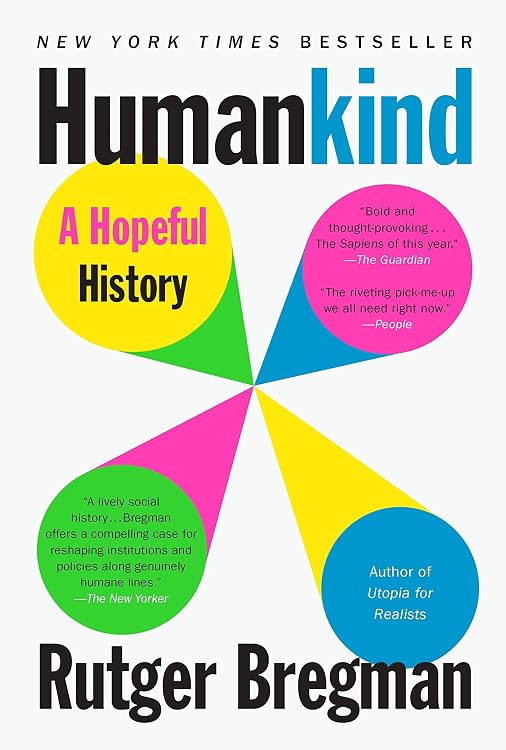
Humankind: A Hopeful History by Rutger Bregman
Humankind: A Hopeful History by Rutger Bregman argues that cooperation and kindness have been central to human history. It uses historical examples and research to challenge accounts that portray people as primarily selfish, making it a fit for readers interested in human nature and society.
At a glance
- Challenges the assumption that people are naturally selfish, making the case for cooperation and trust.
- Uses historical stories and studies, including examples concerning wartime solidarity and the Stanford prison experiment.
- Connects beliefs about human nature to the way society, politics and economics function.
Often bought together

Pros and cons
Pros
- Historical examples and research give readers several ways to consider the argument, rather than relying only on abstract claims.
- The publisher describes the book as written with storytelling and wit, which may appeal to readers seeking narrative nonfiction.
Technical specifications
8 specifications| Publisher | Little, Brown (Trade Div.) |
|---|---|
| Publication date | Nov. 16 2021 |
| Language | English |
| Print length | 480 pages |
| ISBN-10 | 0316418528 |
| ISBN-13 | 978-0316418522 |
| Weight listed | 406 g |
|---|---|
| Dimensions | 13.84 x 3.94 x 20.83 cm |
Who is it for?
A good fit for
- Readers interested in human nature, cooperation and social history.
- Those who enjoy narrative nonfiction built around historical examples and a central argument.
Less suited to
- Readers looking for a neutral reference work rather than a clearly argued case for a more optimistic view of human nature.
Customer reviews on Amazon
- 5 stars
69% 69% - 4 stars
23% 23% - 3 stars
5% 5% - 2 stars
1% 1% - 1 star
2% 2%
Customer feedback describes the book as engaging, readable and thought-provoking, with readers appreciating its optimistic view of human nature, research and storytelling. The feedback also characterizes it as argumentative, which may matter to readers who prefer a more even-handed exploration. These are reader impressions, while the listing presents the book's central case as an argument for cooperation.
Positive themes
- Readers describe the book as engaging, insightful and readable.
- Feedback appreciates its optimism, research and narrative style.
Mixed feedback
- Some feedback characterizes the book as argumentative, so its strongly stated perspective may not suit every reader.
Frequently asked questions
What is Humankind: A Hopeful History about?
Rutger Bregman challenges the idea that people are primarily selfish and presents historical examples in support of human kindness and cooperation.
How long is this edition?
The listing gives a print length of 480 pages.
Who might enjoy this book?
It may suit readers interested in human nature and society who enjoy history presented through stories and a clear argument.
Alternative options

Why Indigenous Literatures Matter (Indigenous Studies)
$15.99

Read People Like a Book: How to Analyze, Understand, and Predict People’s Emotions, Thoughts, Intentions, and Behaviors
$20.12

The Four Chinese Classics: Tao Te Ching, Chuang Tzu, Analects, Mencius
$32.00

Scratching River
$27.99

Literatures, Communities, and Learning: Conversations with Indigenous Writers
$34.99

Violence Against Indigenous Women: Literature, Activism, Resistance
$31.99

Read, Listen, Tell: Indigenous Stories from Turtle Island
$42.99

SPSS Made Easy: A Practical Guide to Statistical Analysis for Students and Researchers
$54.89

Indigenous X: Networks of Relations and Resistance On and Beyond Native Twitter
$42.99